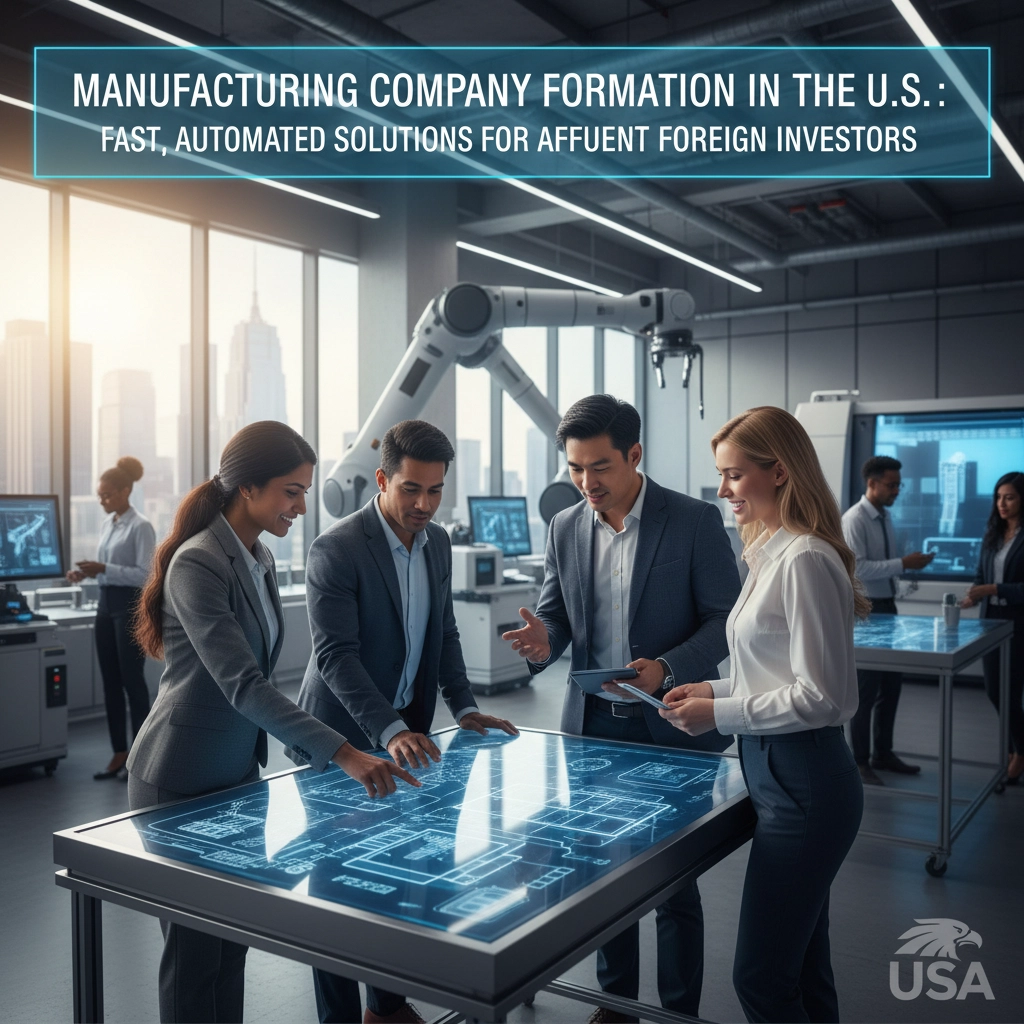
Most foreign investors think U.S. manufacturing setup takes months of red tape… until they discover the automated pathways that get you operational in weeks, not quarters.
The manufacturing renaissance in America isn't just about bringing jobs back: it's about creating smart, automated facilities that leverage cutting-edge technology to compete globally. For affluent foreign investors, this represents an unprecedented opportunity to establish profitable manufacturing operations while securing long-term U.S. business presence.
Why Foreign Investment in U.S. Manufacturing is Exploding
The numbers don't lie: TSMC's $65 billion Arizona semiconductor facility represents the largest foreign investment in U.S. history. Companies like Stellantis, BMW, and dozens of tech manufacturers are pouring billions into American production facilities. This isn't coincidence: it's strategy.
The automation advantage changes everything. When production relies on advanced robotics, AI-driven quality control, and digital twin simulations, labor cost differentials become irrelevant. Your competitive edge comes from technology, not wage arbitrage.
The CHIPS and Science Act alone committed over $200 billion to manufacturing incentives. Add the Inflation Reduction Act's green energy manufacturing credits, and you're looking at the most attractive foreign investment climate in decades.

Your Legal Foundation: Entity Structure That Works
Choose Your Structure Strategically
For manufacturing operations, you'll typically choose between a Corporation or LLC. Corporations offer cleaner pathways for future public offerings or major investment rounds, while LLCs provide operational flexibility and pass-through taxation benefits.
Your entity choice affects everything from tax liability to investor attraction to operational complexity. Most affluent foreign investors prefer corporations for manufacturing because they facilitate equipment financing, attract institutional investment, and provide clearer equity structures for scaling operations.
State Selection: Beyond Delaware
While Delaware dominates for corporate law advantages, manufacturing companies need to consider operational realities. States like Texas offer no corporate income tax, massive infrastructure incentives, and business-friendly regulations. North Carolina provides exceptional workforce development programs and research university partnerships. Ohio delivers low operating costs and central logistics positioning.
Your state choice impacts your tax burden, regulatory environment, incentive availability, and operational costs for decades to come.
The Documentation Blueprint
Essential Filing Requirements
Your Articles of Incorporation establish your legal existence, but manufacturing companies need additional documentation layers:
- Operating Agreements that address equipment ownership, intellectual property rights, and international parent company relationships
- Registered Agent Services that handle legal correspondence and compliance notifications
- Federal EIN Registration through IRS systems, typically completed within days through professional channels
Regulatory Compliance Framework
Manufacturing operations trigger multiple regulatory requirements. Environmental permits for emissions and waste management. OSHA compliance for workplace safety. Industry-specific certifications depending on your product category: FDA for medical devices, FCC for electronics, DOT for automotive components.
The key is systematizing these requirements through automated compliance management systems that track renewal dates, filing deadlines, and regulatory changes affecting your operations.

Automation: Your Competitive Advantage
Smart Manufacturing Technologies
The most successful foreign manufacturing investments leverage automation from day one. This includes:
Robotic Production Lines that operate 24/7 with minimal human oversight, dramatically reducing labor dependencies while improving quality consistency.
AI-Powered Quality Control systems that inspect products at sub-millimeter precision, identifying defects before they reach customers and optimizing production parameters in real-time.
Digital Twin Simulations that model your entire production process virtually, allowing you to test modifications, predict maintenance needs, and optimize workflows without disrupting actual production.
Predictive Maintenance Systems that monitor equipment performance, predict failures before they occur, and schedule maintenance during optimal downtime windows.
The Investment Incentive Landscape
Federal Programs That Pay
The federal government offers substantial incentives for foreign manufacturing investment:
Investment Tax Credits up to 30% of qualifying equipment costs for renewable energy manufacturing, semiconductor production, and advanced battery systems.
Accelerated Depreciation allowing you to deduct equipment costs faster, improving cash flow during critical startup phases.
R&D Tax Credits for developing new manufacturing processes, improving existing products, or adapting technologies for U.S. production.
State and Local Packages
Individual states compete aggressively for manufacturing investment. Texas offers property tax abatements, workforce training grants, and infrastructure improvements. Georgia provides Quick Start workforce training at no cost to manufacturers. Michigan delivers manufacturing equipment exemptions and research facility incentives.
The key is leveraging professional site selection services that negotiate comprehensive incentive packages covering multiple years of operations.

Your Step-by-Step Launch Process
Phase 1: Strategic Planning (Weeks 1-2)
Finalize your state selection, entity structure, and preliminary site identification. Complete market analysis and competitive positioning research. Establish preliminary equipment specifications and automation requirements.
Phase 2: Legal Foundation (Weeks 3-4)
File Articles of Incorporation with your chosen state. Obtain Federal EIN and establish corporate banking relationships. Execute registered agent agreements and compliance monitoring systems.
Phase 3: Regulatory Setup (Weeks 5-6)
Submit environmental permits and zoning applications. Initiate OSHA compliance programs and safety system designs. Begin industry-specific certification processes based on your product category.
Phase 4: Operational Launch (Weeks 7-8)
Finalize facility lease or purchase agreements. Install automation equipment and production systems. Complete workforce hiring and training programs. Initiate production trials and quality certification processes.
Workflow Automation That Scales
Automated Business Operations
Beyond manufacturing automation, your business operations need systematic automation:
Financial Management Systems that handle multi-currency accounting, international tax compliance, and automated reporting to parent companies overseas.
Supply Chain Automation that optimizes vendor relationships, manages inventory levels, and coordinates logistics across international suppliers and domestic distribution networks.
Customer Relationship Management that tracks prospects, manages sales processes, and coordinates with international sales teams or distribution partners.
Human Resources Automation that handles payroll processing, benefits administration, compliance tracking, and performance management for your U.S. workforce.
How Pathway to USA Accelerates Your Success
At Pathway to USA, we've streamlined manufacturing company formation for affluent foreign investors through proprietary automation systems that eliminate traditional bottlenecks.
Our AI-Powered Setup Process handles documentation preparation, regulatory submissions, and compliance monitoring through automated workflows that reduce setup time from months to weeks.
Comprehensive Support Services include site selection assistance, incentive negotiation, banking relationship facilitation, and ongoing regulatory compliance management.
Technology Integration ensures your business operations leverage the latest automation tools from day one, giving you competitive advantages while reducing operational complexity.
Ongoing Partnership provides continuous support for scaling operations, accessing additional incentives, and navigating regulatory changes as your manufacturing business grows.

Your Investment Timeline Advantage
Traditional Timeline: 6-12 Months
Most foreign investors spend months navigating unfamiliar regulatory systems, legal requirements, and compliance frameworks without professional guidance.
Pathway to USA Timeline: 4-8 Weeks
Our automated systems and established relationships with regulatory agencies, legal professionals, and compliance specialists compress your timeline while ensuring complete accuracy.
The Cost of Delay
Every month of delay costs you market opportunities, competitive positioning, and potential revenue. In rapidly evolving manufacturing sectors, first-mover advantages can determine long-term success or failure.
Ready to Launch Your Manufacturing Empire?
The U.S. manufacturing renaissance creates unprecedented opportunities for affluent foreign investors willing to leverage automation and strategic positioning. With federal incentives, state competitions for investment, and advanced technology infrastructure, the timing has never been better.
Don't let complex regulations and unfamiliar systems slow your entry into the world's most dynamic manufacturing market. Our automated setup process eliminates traditional barriers while ensuring your manufacturing company launches with every competitive advantage.
Contact Rachel today to discover how Pathway to USA can launch your manufacturing operation in weeks, not months.
📞 Call Rachel directly: (555) 123-4567
🌐 Explore our services: pathwaytousa.com
✉️ Email: rachel@pathwaytousa.com
Your manufacturing success starts with one conversation. Let's make it happen.
#Manufacturing #ForeignInvestment #Automation #USBusiness #StartupSuccess #Investment #Technology #Innovation #BusinessFormation #PathwayToUSA