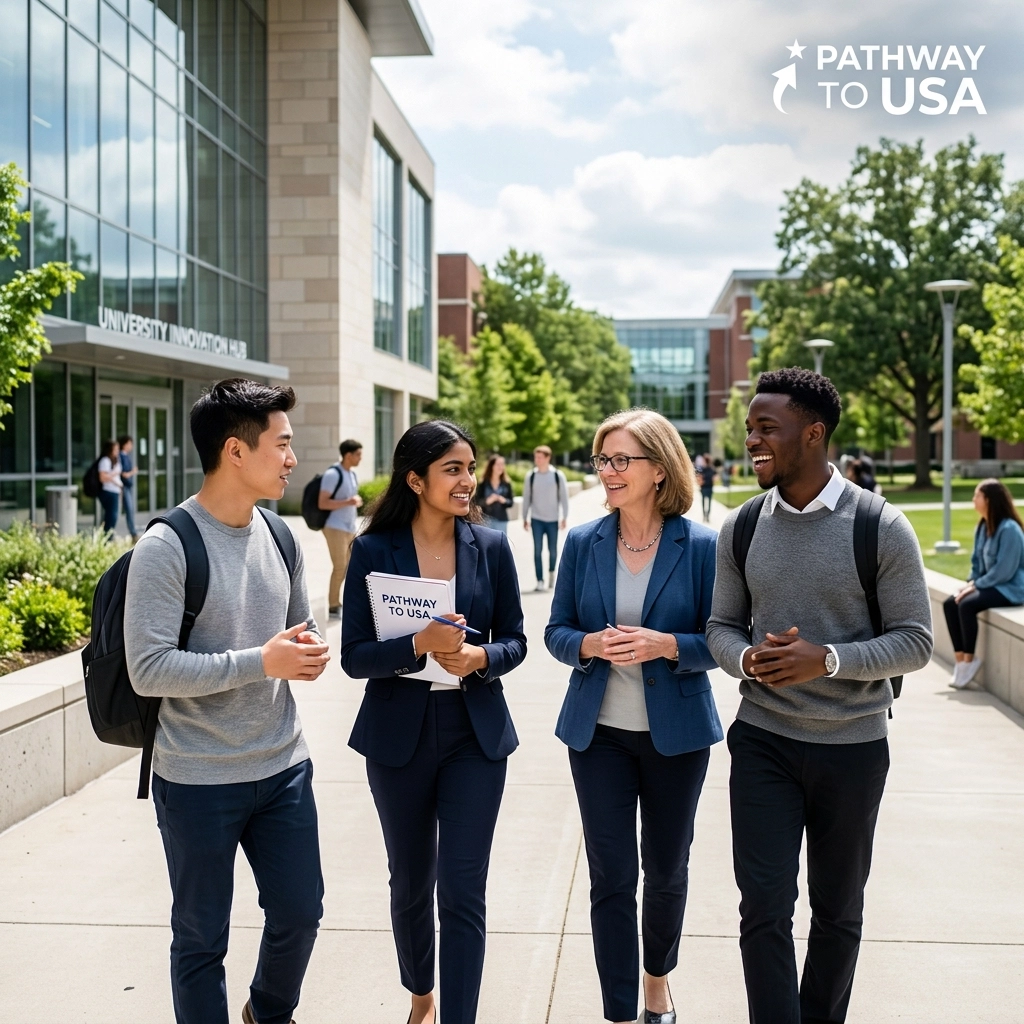
Most investor families think a U.S. college degree is just a standard four-year journey toward a diploma… until they realize it is actually a high-stakes, $250,000+ investment in a rapidly shifting global economy.
Welcome to this week's edition of the Pathway to USA Newsletter. Today is Saturday, May 16, 2026, and if you are a globally-minded family looking to secure your children’s future while navigating the U.S. immigration landscape, you need to look beyond the prestige of a university’s name. U.S. higher education is evolving faster than it has in the last three decades, and for the savvy investor, these changes represent both a challenge and a massive opportunity.
At Pathway to USA, we don't just help you get your visa; we help you build a legacy. Whether you are pursuing an E2 Treaty Investor Visa or an EB-5 Immigrant Investor Program, your family’s educational path is often the "why" behind your move.
Here are the 10 innovation trends reshaping U.S. colleges and what they mean for your family’s residency and investment strategy.
1. ROI and Outcomes Transparency Move to Center Stage
The days of choosing a college based solely on a "feeling" or a historic brochure are over. Public pressure and new federal regulations are forcing U.S. institutions to prove that their degrees pay off. Schools are now being measured by graduation rates, median earnings after graduation, and loan repayment success.
What this means for you:
When evaluating colleges for your children, favor institutions that publish detailed, major-specific outcomes data. Look for schools that have robust career services and active employer partnerships. A university that is transparent about its ROI is one that is confident in its ability to launch your child into a high-earning career: a critical factor for families looking to maintain wealth across generations.
2. Campuses Become Strategic Real Estate & Innovation Hubs
Forward-thinking universities are no longer just clusters of classrooms; they are becoming "innovation districts." By partnering with private developers, hospitals, and tech giants, these schools are creating mixed-use environments where students live, work, and innovate alongside industry leaders.
What this means for you:
If your student is interested in entrepreneurship or STEM, look for universities anchored in these ecosystems. These schools often see higher enrollment growth and offer better internship access. This trend also mirrors what we do at Pathway to USA: we help you get pre-qualified to launch businesses that can thrive within or alongside these very innovation hubs.

3. “Digital-First” Learning Becomes the Baseline
By 2026, the "Zoom lecture" has been replaced by sophisticated, high-quality hybrid learning models. Students now expect the flexibility to mix in-person and online courses, allowing them to accelerate their degree or work on a startup while they study.
What this means for you:
Flexibility is a luxury for the modern investor family. If your student is helping with a family business or pursuing an internship in another state, a university with a mature "digital-first" infrastructure is essential. Check for 24/7 tech support and virtual advising: these are the hallmarks of a resilient modern institution.
4. Generative AI and New Colleges of Computing
AI has moved from the computer science department to the entire campus. Many top-tier universities are establishing dedicated "Colleges of Computing" that integrate AI literacy into every major: from business and health to the liberal arts.
What this means for you:
Even if your child is a budding artist or a future CEO, they need AI literacy. Ask admissions officers how they are integrating ethical AI use into the curriculum. In our own work at Pathway to USA, we use workflow automation AI to help our clients simplify their daily business operations. We believe your student’s education should reflect this same commitment to modern efficiency.

5. Career Pathways and Work-Based Learning Expand
The U.S. is doubling down on Career and Technical Education (CTE) and apprenticeships. The goal is to ensure students are "measurably better off" the day they graduate, possessing both a degree and a portfolio of real-world experience.
What this means for you:
Prioritize programs that integrate "Co-op" models where students spend semesters working in their field for pay. This not only builds a resume but also provides the networking necessary to secure H-1B sponsorship or future investor visa status for the student themselves down the line.
6. IT Resilience and Cybersecurity as a Competitive Edge
As education goes digital, the security of your family’s data and your student’s academic records is paramount. Innovative universities are investing heavily in cybersecurity and managed IT services to protect their research and their community.
What this means for you:
A university’s technological stability is a direct reflection of its management quality. Look for modern student portals and a clear commitment to data protection. This is particularly important for international families who may have complex financial and legal profiles.
7. Modular Partnerships Replace Old Models
Universities are "unbundling." Instead of trying to do everything themselves, they are partnering with specialized firms for enrollment, marketing, and online program design. This allows them to focus on what they do best: teaching and research.
What this means for you:
These partnerships often lead to better student support services. When a school uses a specialized partner for career coaching, for example, the quality of that coaching often exceeds what a traditional internal department could provide.
8. Holistic, Personalized Student Support
Attracting international students is more competitive than ever. To keep them, universities are investing in success coaching, mental health wellness, and proactive advising.
What this means for you:
For a student moving to the U.S. from overseas, the transition can be challenging. Look for schools with low advisor-to-student ratios and dedicated support for international students. Our team at Pathway to USA often helps families navigate these cultural transitions, but having a supportive university environment is the other half of that success equation.

9. Competition for Students Intensifies
With demographic shifts and the rise of alternative education (like bootcamps), colleges are fighting for every enrollment. This gives you, the investor family, more leverage than ever before.
What this means for you:
Use this competition to your advantage. Compare response times, scholarship offers, and personalized outreach. If a school isn't working hard to earn your student's enrollment, they likely won't work hard to support their career after graduation.
10. Private Capital and Alternative Education Models
Venture capital is flowing into "non-degree" pathways like coding bootcamps and specialized skills academies. Many families are now taking a hybrid approach: a traditional degree for the network and prestige, supplemented by intensive, short-term skills programs.
What this means for you:
Don't be afraid to think outside the traditional four-year box. Sometimes, a targeted certification in a high-growth field is the perfect complement to a university education. This "entrepreneurial" approach to learning is exactly the mindset we encourage in our clients who are launching businesses in the U.S.
How Pathway to USA Supports Your Family’s Vision
Choosing the right college path is only one piece of the puzzle. If you are moving your family to the United States, you are likely looking to launch a business that reflects your passions. Whether it’s a tech startup, a consulting firm, or a specialized service, we are here to guide you through every step of the immigration process.
We specialize in helping wealthy immigrants and investors navigate the complexities of U.S. residency while setting up their business for long-term success. Our use of workflow automation and AI ensures that your business operations are simplified from day one, allowing you to focus on what matters most: your family and your student’s education.
Your Investor Family Checklist for College Visits:
- Outcomes: Do they publish salary data by major?
- Ecosystem: Is the school connected to a research park or tech hub?
- AI Readiness: How is AI integrated into the non-tech majors?
- Support: What specific resources are available for international/investor families?
- Flexibility: Can the student work on a business while completing their degree?
In 7 days, you could have a clear strategy for your family's U.S. residency and your children's educational path. Don't leave your legacy to chance.
Ready to start your journey?
Click here to get pre-qualified and speak with our experts.
Contact Information
For personalized guidance on U.S. immigration and business setup, contact our team:
Rachel
Phone: [Insert Phone Number/Contact Details]
Website: https://pathwaytousa.com/contact
#Innovation #U.S.College #Immigration #InvestorVisa #E2Visa #EB5 #EducationTrends #Branding #Strategy #DigitalMarketing #PathwayToUSA #Motivation
For more insights, check out our related posts: